Musisic, or, the Long & Slimy Tendrils of Gradient Descent
Sometime in 2025 I realized that when I sit down with just my guitar and try to noodle around I feel a sense of dread like everything I could make has already been decided for me. "Musisic" is a set of guidelines I have made for myself to make me not dread the process of making music.
I am particularly concerned with the problem of what it takes to actually make something new; not just new as in "not plagiarized," but new as in "surprising." There exist a functionally infinite number of "new" four-chord dream-pop tracks that could be arranged into existence but few of them would sound surprising even if none of them are technically copies of one another. But what is new as in "novel?" Or, as in - "I hadn't thought that you could do that?"
Generative AI tools for music haven't crested the "generating hands with the wrong number of fingers" threshold, yet. But as someone who (regrettably) knows too much about how these systems work, I hesitate to say that they never will; not that I expect them to make things that are worthwhile, but it's conceivable that they become able to create things that are harder to aurally identify as AI-generated within the first few seconds. I want to future-proof my process against this,so that nothing I make could ever be confused for the output of Suno, no matter how much training data and compute power they have. But how can I, a creator who has only ever consumed media that already exists, create something that isn't just an interpolation between two works I already know?
Who writes your metric?
When you plug in a prompt to Suno or Stable Diffusion or whatever people are using nowadays and get out a fresh warm slice of content, who is the artist? The most popular answers are 1) You are, for coming up with the prompt; 2) The authors of the model's training data, for creating the raw material that you have just rearranged; or 3) Nobody at all, because this is not art. Well, 1) is masturbation by the most boring people in the world; 2) sounds nice but doesn't really map onto how lacking in variation the outputs are; and any attempt to argue over questions of what is or isn't art as in 3) is pointless. The only answer that is worth thinking about is the less popular 4): the authors of the model themselves. They ultimately decided how the model should work, and therefore decided what rules govern how inputs get turned into outputs. They're the ones who've created something - I mean, it sounds and looks bad, invariably. But it was created. If not at the time of prompting, though, then when, exactly, did the act of creation happen?
Well, when the engineers at Suno or Udio or whatever want to train a generative model, they set up a dataset of music, a loss function, and a training scheme. These jointly define a metric. A metric draws a boundary inside the space of all possible audio files and says "these score well" and "these score poorly," giving you a gradient that a model can train on.[1] They use the process of gradient descent along this metric to train a generative model, and if they've gotten all the fiddly little machine-learning bits right, they've created a model whose sole purpose is to pluck audio files out of the ether that score well. The ideal model is a transparent, unthinking thrall of the metric it's trained on. When you prompt this model you're just poking at it and getting it to reveal a decision already made by the underlying metric. So, my argument is that the act of creation is in the design of the model itself - the coding of it, the selection of training data and loss function and training schedule - not in the training or the prompting or anything else. In this view, all audio files that can be generated from this model were created the moment they finished the design document for the metric. If this seems strange... well, at what other point in this process could we possibly say anything was created?
I'd take this further. I propose that:
To design a metric that assigns scores to works so that they can be numerically compared with one another is, for any discussion of creativity and authorship, the same act as creating all works that maximize that metric.
In other words: Any process that takes in audio (or words or images or video) and outputs something quantifiable defines a corpus of music (or prose or visual art) in its entirety as soon as it is constructed.
Human Models
This does not only apply to systems based on machine learning. A metric can be a loss function, an earnings chart, a listener retention statistic, the number of times something was reposted, whatever. Long before anyone thought to do machine learning, there was content, and there were metrics that people wanted content to reach, and this led to people optimizing content to maximize metrics. You can't reckon with the cultural position and aesthetic of generative AI without noticing that its results ("slop" and the million other names that slop goes by) were in demand long before Sam Altman trapped us all in his neverending fifteen minutes of fame.
Spotify is an exceptional example here because they had the bright idea to flood their own platform with Gen AI content before anyone had built the technology capable of that, so they kind of had to do Gen AI manually. Since the mid-2010s, Spotify's Perfect Fit Music initiative commissioned an endless deluge of music for specific playlists and specific moods, with the goal of keeping people's ears captive to a dripfed diet of music that Spotify wouldn't have to pay anyone else for. The metrics determined not only the method of content delivery[2] but the content itself. Even if real people were hitting drums and plucking strings somewhere in this process, there was still a signal from every successful stream whose effect was traced back through the algorithms that built the playlist and the algorithms that decided to serve that playlist to that user and the decisions of what music to commission when, and by who, and what to tell them, and how to name the fake artists, and what stock photos to use for cover art; decisions spread across marketers and engineers and executives at a single company, yes, but all to make a particular number go up.
The process of corralling actual humans into a tiny, sweaty studio to churn out dull chillout grooves based on hastily written prompts from a data-crunching office in Stockholm is less direct a process than training a audio diffusion model would be (call it a "weakly supervised" training regimen) but it's still a process whose goal is to create a model that reproduces the decisions of a metric. The model's just got humans in it because they didn't yet have to tech to remove fleshy bottlenecks. What is Perfect Fit Music if not gradient descent reinvented from first principles, passing through a corporate structure rather than a GPU?
Optimization Slimes Into You
More generally, the design of music streaming platforms has changed the kinds of music people make. The statement "The design of music streaming platforms has changed the kinds of music people make" is trite, at this point, but what I'm talking about is not quite that, so please bear with me.
Outside the scope of Spotify's own bespoke musical works, when the execs at Spotify decide how their platform works (the precise design of their monetary incentives, where the user interface focuses a user's attention, the emphasis on playlist placement and chill-out background fluff, the exact threshold of thirty seconds as the point where a play is registered) they've created a metric that judges the music everyone makes. Of course, not all artists who distribute their work to Spotify care about succeeding on that platform. But many do, and those who do care will shape their output to score well on the tests Spotify has put out for them. This process shapes the environment in which you consume and create music, affecting the taste of all listeners and the habits of creators, whether or not they use Spotify; indeed, the artistic intentions of even the Spotify-avoidant are pulled in a particular direction by listening to music made by people who did pay attention to their stats: the signal defined by the Spotify execs backpropagates through the entire music industry (call it a "very weakly supervised" training regimen).
Perhaps you can see where I'm going with this:
In the same way that the team at Suno created all music that can be generated with Suno as soon as they designed Suno, the team at Spotify had a hand in creating all music that would ever succeed on Spotify as soon as they decided how Spotify would work. Those decisions are, in effect, creative decisions. Maybe you recorded the notes yourself, but Daniel Ek was in the room and he made calls that you didn't get to. At very least, you collaborated with him. In the limiting case, if you really care about playlist placement, your role is that of a copy-editor, or a composer's assistant, turning someone else's sketched-out instructions and blueprints into a consumable Product (derogatory). The true form of the thing, its skeleton, was already designed before you ever had a spark of inspiration.
You can ignore these platforms and their metrics altogether, sure, but they aren't ignoring you.
For other media you can talk about more varied ways of creating novelty, but music is, in a purely informational sense, the medium that relies the most on repetition and reference.[3] When an art appreciator looks at a painting of a landscape they can compare it to the sensation of seeing an actual landscape; when a listener hears music they can only interpret it in the context of other music. You are not immune to this, no matter how elevated you think your musical taste may be! There is no way to avoid being molded by your environment. The raw signal of audio hitting your eardrums is heavily "chunked" and preprocessed by your brain before you become conscious of it.[4] If you choose music to listen to in any rough proportion with its overall popularity, then signal induced by metrics created by very rich idiots is always sliming its tendrils into your audio processing centers and fiddling with the switches.
Spotify and Suno are not unique. Apply this framing to what it takes to trend on ArtStation, or how to get readers to pay attention to your book. What about the entire field of advertising? How do radio stations choose what music to put on the air? What in hell is going on with musicians trying to advertise themselves on TikTok?[5]
We've been gradient-descending as a species ever since someone first profited off of being popular, but previously there was a lot more friction in this process, and the path by which metric turns into content was confounded by individual taste, budgetary concern, ego, talent, interpersonal conflict, miscommunications, and the physical capabilities of the human body. I don't think any of these observations I've made are all that new; what is new is that the machines (both social and technological) through which gradient descent flows[6] are churning now faster than ever. Even where generative AI has no obvious place in the production of content, feedback is increasingly instantaneous, and there is probably some machine-learning system that helps determine who sees it in the first place. Notice the proliferation of metrics and increasingly cluttered "dashboard" pages for any distribution platform: YouTube and Spotify, in particular, seem like they were made to induce as much anxiety in the viewer as possible.
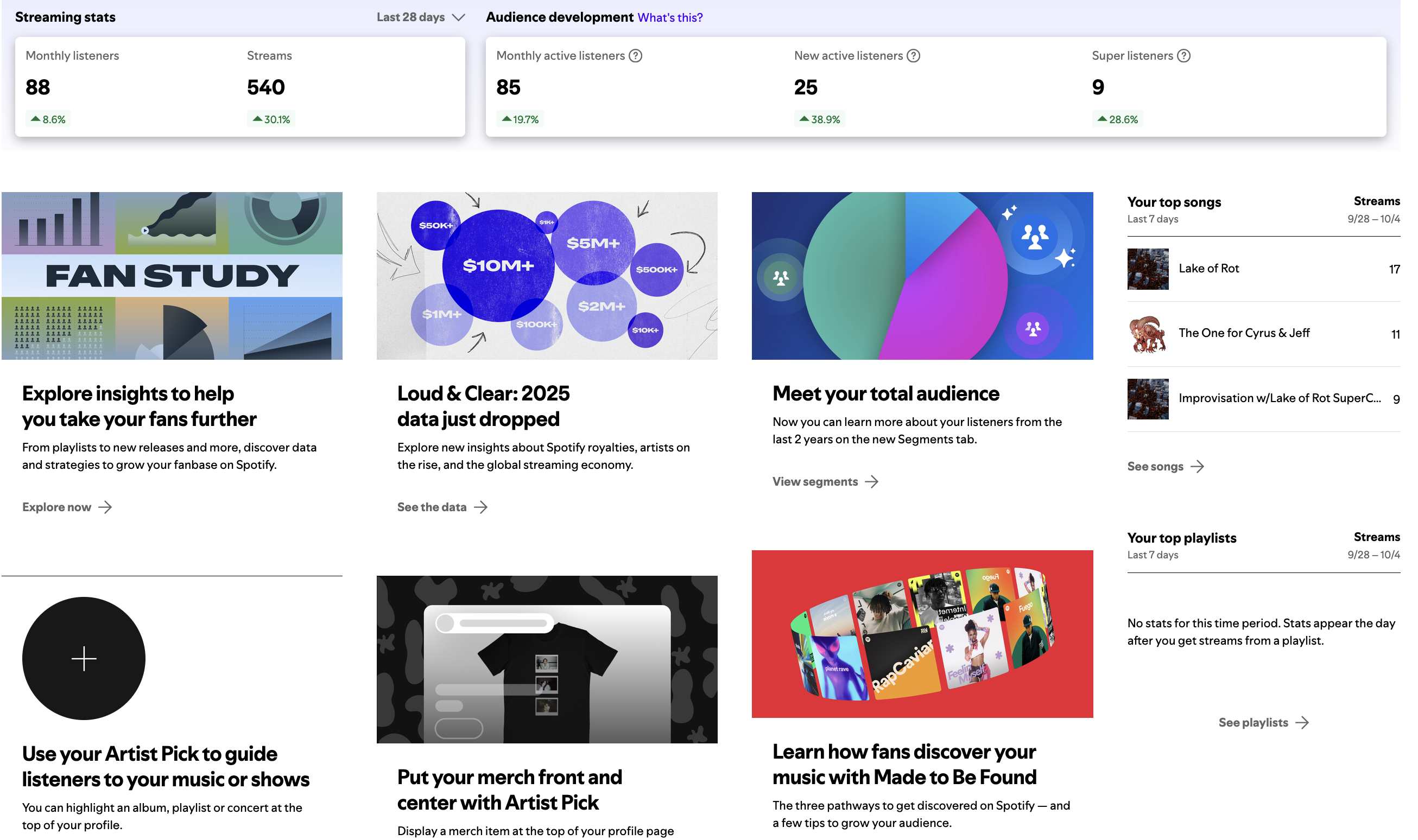
Put something out, get feedback, see numbers, get graphs, put something else out. Release more often. No, more often than that, even. Act on FOMO. Change your behavior and then get told how your change in behavior changed your numbers, which tells you how to change your behavior again. The metric was written somewhere else and you are the model being trained to maximize it.
Chopping Off the Signal
Here are, in ascending order of usefulness, the strategies I can think of which can help you make music outside the influence of these forces in the year 2026:
-
Revert to a prelapsarian state wherein your brain has never heard of Olivia Rodrigo. This is the realm of the outsider artist, who is wholly self-taught or otherwise unaware of conventional norms. I wish I could be an outsider musician, but that ship has sailed. Alternatively, you could steal from those who haven't yet heard of Olivia Rodrigo. In the 20th century it was very chic to filch some ideas from another, less-metricized culture's musical traditions, and that kind of recombination could be surprising, at least to the listeners back home. That was never a renewable resource, though, and the global south have all developed their own pop music scenes now anyway, so you're going to have diminishing returns if you're just trying to write the next "Graceland."
-
Be part of a tightly-knit scene. If you're getting your music influences from people near you, and they're getting influenced by you, and you're all commenting and encouraging particular things, then you can make enough signal amongst yourselves to overpower the dulling effects from above. I'd like to do this. Unfortunately, I'm a homebody, and very shy, and everything interesting in the city where I live happens past my bedtime.[7] Besides, these days it's nearly impossible to run a "small venue" in any major city in North America and break even.
-
Deliberately create in directions that you know would ruin your art's performance on some metrics you don't like. This can create things that sound new, I think, but I don't find it fully satisfying. We're still using the same metric; we've just flipped the score around. I don't want to look at things I don't like and say "Well, I'm going to do the opposite of that." If I'm holding myself to that restriction, then I haven't made any decisions myself, yet, have I? I've still let the things I don't like decide what I should do.
-
Come up with some new metrics yourself.
Ah! Now we're talking about Musisic.
Why not? If the design of a metric is in itself an act of artistic creation, then the cleanest way to get yourself to make something interesting is to put a significant amount of effort into the creation of that metric in the first place. You have to define a new way of judging the worthwhileness of art that neither directly rejects your previous instincts outright nor affirms them too closely. Once you've decided, then you put your actual technical skills to work as loyal employees of this decision. Train yourself to be a model that generates something worthwhile.[8]
Again, this isn't original: "moderating your own influence on your own music" is a school of thought that traces back at least as far as Schoenberg and 12-tone music. Surely John Cage was thinking of this to some extent when he began working with indeterminacy and the I Ching as sources of compositional material, and surely Brian Eno had some of this stuff on his mind when writing the Oblique Strategies. But this kind of mindset needs to make a resurgence, these days.
I realized recently that when I sit down with just my guitar and try to noodle around I feel a sense of dread like everything I could make has already been decided for me. "Music" (Not music but "Music", the cultural activity, the thing we talk about and discuss that exists in a public consciousness, the collective "Music" as opposed to the raw sensory phenomenon of music) has been subdued, wrangled, completed, dissected, and catalogued, and the most I can do with it is puppet it around. I am leaving it behind on the battlefield. I want to make something not so easily compromised. Something that Suno or Spotify's Perfect Fit Music program could not make, of course, but also something that could not be made by a disinterested human artist: something that you could not get from any generative process, human- or machine-led, that follows the same metrics the modern music industry operates under. Au revoir to "Music." I am now digging up "Musisic."
Techniques for Writing Musisic
That was all preamble, I guess. These are some of the principles I am working with to help train myself to maximize new metrics.
-
Begin from the presumption that you cannot use your own instincts. Act as if your own sense of taste has been infiltrated by rogue agents. Create, initially, with a blindfold on so that you can't judge your own work. You can judge something after you've made enough of it that you can speak its language.
-
Don't lean on randomness to create interest. All white noise is perceptually identical. This applies just as well to random melodies, random rhythms, etcetera. In the limit, everything determined by pure chance starts to sound the same. Get input from something that has structure, in a way that the structure shows up perceptually in the music.
-
If there is a textual or representational component, don't write about yourself. At least, try very hard not to write about yourself. Not just because you are, statistically speaking, not that interesting[9] but because it's a useful exercise to plumb other depths for interesting material: history, fantasy, etcetera. Once you're good at getting material in from outside, there's so much more of it to go through than can come from just you.
-
Constraints (à la Oulipo) can be interesting to work with, but an arbitrarily chosen limitation is not all that much better than inserting dice rolls into your compositional process. Instead of adding a constraint, identify a constraint you were holding yourself to and remove it, giving yourself an additional degree of freedom: something that can vary in the musical surface that previously was fixed (e.g. the tempo, the time signature, the key, the tuning system, the drum compression, the EQ, the global pitch bend, the anything you usually don't mess with). Now there's something you're allowed to do that you weren't allowed to do before. Decide that you have to do it at least a certain number of times.
-
You don't have to pretend not to care if anyone listens (I certainly do!), but you have to not think about your audience's pleasure too much. Instead of trying to appeal to what they think is catchy or pleasant or majestic, try to evoke states that are not often reached for. Think about your audience, specific people with specific influences, and what it would take to unsettle them, or disgust them, or give them a shot of adrenaline, or deliberately pull the rug out from under them, or overwhelm them, or intrigue them, or scare them, or confuse them.
-
Define processes (à la Process Music) that are deterministic but that are too complicated for you to be able to predict their outcomes. This is easiest to do in code (chaotic systems, quasirandom number generation, fractals, iterated function systems, etc), which is my preferred route these days, but it's doable in any workspace. Download raw data from government sources and decide on rules for converting it into chord progressions. Pick out field recordings that upon first listen do not spark any particular inspiration. Decide you're going to record some thing (the clacking of a series of particular objects together) and commit beforehand to using it even if your initial reaction is that the result is unusable. The important thing is to make sure you don't fully understand what it will sound like when you start making it.
-
If repetition legitimizes, then do some repeating. Take something that doesn't sound good but that you think could sound good, or might sound good to someone else in a way that interests you. Put it on repeat while you do something else. Listen to it on different headphones and in different spaces. Notice different things about it. Your brain will analyze it, chunk it up, categorize it, and make sense of it. Now you're a connoisseur of this one patch of material and your instincts about it are fundamentally new. Both the cueball and the white-hat strawman guy in this ancient XKCD strip are actually in the right.
-
Come up with a new vocabulary to describe your work that only makes sense to you, and talk about your own stuff with this vocabulary. Talk about it to the wall. Write notes in a notebook. Squawk about it to an uncomprehending friend. In this vocabulary, use words in strange and diagonal ways over and over until they start to make sense to you. Then you can consciously decide to focus on particular aspects that were previously difficult to put into words.[10]
-
Identify things that are naturally easy to do in your music-making software or hardware of choice and never do the more convenient thing. Less convenient things are better. Change time signatures often even if it's a pain in the ass - because it's a pain in the ass. Automate the un-automatable. Make your mixer routing into an untenable mess. Link parameters that were not meant to be linked together. Use effects and instruments for applications orthogonal to their intended purpose, specifically where it's finicky and irritating to do so.
-
If you want to write something that is "inspired by" something else you've heard, here is an exercise that has worked very well for me: Stop listening to that other thing that you are inspired by, entirely. You're no longer allowed to listen to it until you've completed the piece that it inspired. Write down in specific but anonymized terms what was interesting about it and then put it aside for a week or a month. Then, work from your notes. The effect of language and the weird attenuations of fading memory will bring out a minimal, dense nugget of interesting information that you can add to your own art, satisfyingly, without the result being obvious to anyone but you. In this way you can pick at a little thread and prise it out from the great haze without getting smothered by context.
That's what I got. I have been doing this for a year now and I feel like I enjoy making music again.
The album "Training Musisic" is what I wrote while thinking through this stuff. Using Supercollider and other low-level music programming languages is a very good way to be able to insert alien influences in your work (the design of DAWs are themselves heavily influenced by the kinds of music they expect you to be creating). But only in places on this album did I really pick an overarching direction and stick with it. The more guitar-centric tracks were all written on a guitar first and then kind of rewritten into code, but these are not as successful as musisic, I think, because there was less friction in that process and I kind of knew what I wanted it to sound like when I began. The Supercollider components turned into a distracting seasoning on a song that otherwise abided by the rules of a genre. The longer ones are much better in this way, though I still made them a little more personal than I would like in future. Hence why it is all still "Training" musisic. I will do much better next time.
Strictly speaking, it is more like "given this prompt that was pre-processed by an LLM, this audio file matches the prompt more than this other one does." But I will assume here that a generative audio model is just a black box with one button that you press to get out some audio, with no other levers. You could adapt my argument for the conditional generation that these models actually do, it would just be wordier and harder to read. ↩︎
See: Pelly, Liz, Mood Machine: The Rise of Spotify and the Costs of the Perfect Playlist (2025), though I get the impression that everyone who is interested in this stuff has probably already read it. ↩︎
See: Margulis, Elizabeth Hellmuth, On Repeat: How Music Plays the Mind (2014). Highly recommend this book to a general audience. ↩︎
I distinctly remember listening back to Daft Punk's Discovery, an album I memorized and obsessed over as a tween, after I'd been producing music for nearly a decade. I couldn't shake the feeling that it sounded different. I'd spent so long auditioning snare drums and agonizing over the snaps and transients of kicks and hi-hats that now those things just sound noticeably louder to me now -- my mind cannot not hear individual components of the mix, but when I was a kid I could pay attention to "Crescendolls" as a pulsating blob of synthesized atmosphere, all at once. This kind of effect is attested in literature on psychoacoustics, for what it's worth, though I don't think anyone's studied it for producers specifically. ↩︎
I was about to go on TikTok and look at the humiliation rituals that bands do in attempts to go viral - trying to make a point about how the way people use short-form video shapes how songs are written when they're being advertised there - but it was truly so hard to watch that I did not have the heart to collect any more evidence. I'm sorry. I can't do this "POV What if a band from Ohio blended 100 gecs with gothic aesthetics" stuff. Leave this part of my argument as an exercise to the reader or something. ↩︎
As a certain segment of readers will guess, I did have a period in my 20s where I tried really hard to read Deleuze. ↩︎
You might retort by saying, well, what about online music scenes? Can't they be innovative and tightly knit? I guess so. I have complicated feelings here. I think part of my resistance is I just don't love a lot of the stuff that people hold up as examples of music that originated in internet scenes, even when I recognize that it's new and surprising. Another part of my resistance is that I don't want to join any more discord servers. Maybe I've got rockism (the disease). ↩︎
To be clear, I am very much not saying that you should only "focus on higher-level ideas" or "think about the big picture and ignore details of implementation" which are things that LLM-likers like to think Claude helps them do. A metric, in this context, is not an excuse to treat art-making the same as prompting an LLM; it's not a vague design document that you can fill out. It's an evaluation mechanism that guides you to weigh one decision as better than another decision. You still have to make all those tiny decisions. ↩︎
If you actually are interesting enough, you can disregard this and I'm sorry for doubting you. ↩︎
Inspired in part by how Autechre have their own little bank of terms they use to categorize their pieces. You can see glimpses of this in their song titles. One of them says "yeah, that one's a casual." or "that's a pendulu". or "that's a gonk". do you remember gonk. God, I remember gonk. We used to have so much fun with gonk. I wish they'd release an album again so we could have more song titles. ↩︎